Paradigm Shifts: 2025
Written 28 December 2025; by Charan Pushpanathan
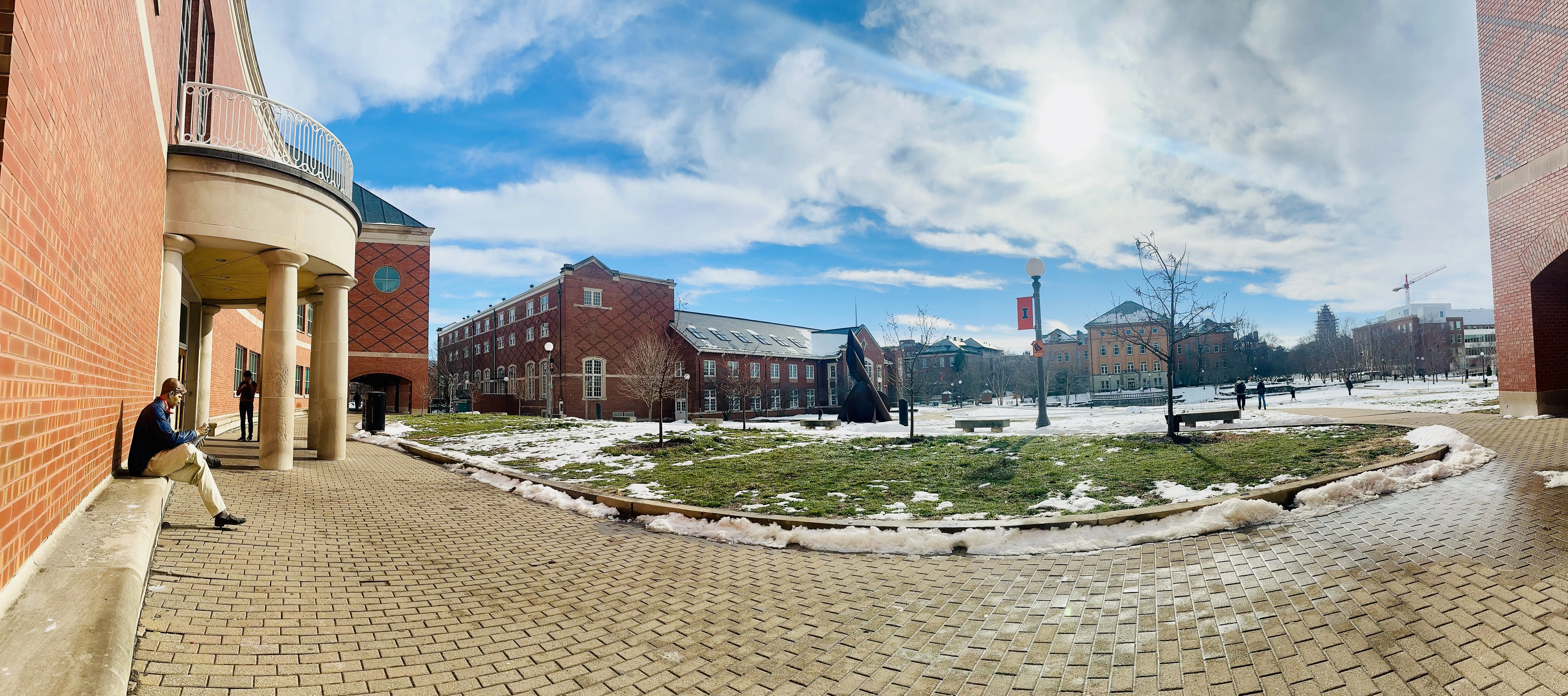
Grainger at the winter break of 2025
As an ending note for 2025, it's been a high adrenaline rush with lots of incidents. I'd like to share a few of these moments and what I've learned and continue to learn from them. All views expressed here are my own.
This year has given me time to think about the United States as one of the great countries advancing science, and about my own journey from Penn State to the University of Illinois Urbana-Champaign. But more than that, it's given me reason to examine what "paradigm shifts" really means. Not just in science though that's central but in how we see ourselves, what we value, and why we do, what we do. The questions I've encountered from friends and strangers have pushed me to articulate beliefs I didn't know I held. In answering them, my own thinking has shifted. That's what this essay is about, the moments in 2025 when my perspective fundamentally changes because as I forced to examine it.
1. Why a PhD? And what actually pushed you to say yes to it not the degree, but the life?
A doctorate in philosophy is a different kind of world mad, fuzzy, successive, and full of failure. It's young. Someone holds you by your shirt and asks you to sit down and think deeply about something within your interests, and that thinking transforms into science[1]. At least in computer science, I was clear from my undergraduate years: "don't try to build a car, build good roads to drive it." I said something similar in a PhD interview when asked why I wanted to pursue one: "I don't want to build a text editor. I want to understand how people think in texts and align everything from thought to composition on a tool." Six months into the program, when people ask how my research is going, I say it's good to explore the fallacies of the world we've made and try to make the place better. When they ask what my research is about, I say "The sciences of the artificial."
The phase of doing engineering has passed for me. It's been a short road, but I've learned a lot, and nothing surprises me anymore. The intentional stance differs between science and engineering: science aims to create new knowledge about how systems work; engineering aims to create systems that achieve goals. One example that helps me think about what distinguishes science from engineering, especially as a PhD student at UIUC, is John Bardeen, who spent much of his career here. Bardeen did not arrive at superconductivity through abstract mathematics alone, but through close attention to experimental and material realities. The BCS theory emerged only after persistent engagement with engineered systems exposed patterns that theory could not initially explain. In that sense, engineering practice did not follow science it actively reshaped it. Remembering Bardeen at UIUC reminds me that building, failing, and revising are not distractions from science; they are often how science advances. Science made me think about the world we live in interests me more than where I live. I want to dedicate my time to creating science as a science worker, and I'm very excited about my research.
2. Are you doing this because you love science, or because you want to be called a scientist?
Most of what I explained in question one above applies here. In short: yes, I love science. Because I love science, I do science. That puts me into an overwhelming category it makes me fail, but the more I fail, the more confidence I gain to keep doing it. It has broken some of my skepticism, because I feared doing things. I realized that whether I'm called a scientist in future or not, I'm still contributing as a science worker.
Two things I came across speak to this. First, C. Subramania Bharati on fear and skepticism:
அச்சமில்லை அச்சமில்லை அச்சமென்பதில்லையே இச்சகத்தூளொரெலாம் எதிர்த்து நின்ற போதிலும் அச்சமில்லை அச்சமில்லை அச்சமென்பதில்லையே
துச்சமாக எண்ணி நம்மைத் தூறு செய்த போதிலும் அச்சமில்லை அச்சமில்லை அச்சமென்பதில்லையே
பிச்சை வாங்கி உண்ணும் வாழ்க்கை பெற்று விட்ட போதிலும் அச்சமில்லை அச்சமில்லை அச்சமென்பதில்லையே
இச்சை கொண்ட பொருளெலாம் இழந்த விட்ட போதிலும் அச்சமில்லை அச்சமில்லை அச்சமென்பதில்லையே
கச்சணிந்த கொங்கை மாதர் கண்கள் வீசுபோதிலும் அச்சமில்லை அச்சமில்லை அச்சமென்பதில்லையே
English translation:
There is no fear, there is no fear, there is nothing called fear. Even when all those around stand against us, There is no fear, there is no fear, nothing like fear.
Though they despise us and treat us as worthless, There is no fear, there is no fear, nothing like fear.
Even if we live by begging for a meal, There is no fear, there is no fear, nothing like fear.
Even if we lose all our treasured possessions, There is no fear, there is no fear, nothing like fear.
Even if the angry eyes of enemies glare at us, There is no fear, there is no fear, nothing like fear.
Chinnaswami Subramania Bharathi or Mahakavi Bharathiyar celebrates fearlessness and moral courage, urging people not to cower even amid scorn, poverty, loss, or hostility. I've taken bharathiyar thoughts like a remedy for fear. Fear should not rule the self.
And second, William Shakespeare on names:
"What's in a name? That which we call a rose by any other name would smell as sweet. So Romeo would, were he not Romeo call'd, retain that dear perfection which he owes without that title. Romeo, doff thy name; and for that name, which is no part of thee, take all myself." - from Romeo and Juliet
Shakespeare argues that names, labels, and titles are social constructs, not the essence of a person or thing. I cite this because names should not define the self.
3. Why the United States? Is it really about opportunity, or about escape?
Measuring is a fallacy until someone convinces me why measuring things is good or I need to take a step back and reconsider.
I'm not going to argue that the United States is better than other countries. Instead, I reframe the question: why is the U.S. one of the countries that has consistently done a good job in science?
My belief is that one defining characteristic of a flourishing country is the value it places on science itself. For many decades, the people of the United States have treated science not merely as utility, but as a public good something worth funding, protecting, arguing about, and passing on. This respect shows up repeatedly in history.
Fundamental theories in physics, such as quantum electrodynamics, developed and refined by Richard Feynman, Julian Schwinger, John Bardeen, and John Wheeler were not pursued because they promised immediate applications, but because understanding nature mattered. At the same time, institutions like Bell Labs, RAND produced inventions that reshaped the modern world: the transistor, information theory, and the foundations of digital communication. The same culture carried into computing.
At Xerox PARC, ideas like the graphical user interface, the computer mouse, Ethernet, and object-oriented programming emerged not from a single product mandate, but from giving researchers freedom to explore. Earlier still, Ivan Sutherland's Sketchpad demonstrated interactive computer graphics, laying groundwork for CAD, HCI, and modern visual computing. These were not incremental optimizations they were conceptual leaps.
What ties these together is not nationalism or exceptionalism, but infrastructure for curiosity, long-term funding, research universities, national labs, tolerance for failure, and an unusual willingness to let theory and engineering co-evolve. In the U.S., physics did not stay confined to blackboards, and engineering did not reduce itself to applied mathematics. They met, sometimes clashed, and in that friction produced new knowledge.
This is the kind of ideology I like in a country, and it's good to do work starting from Pennsylvania State University to the University of Illinois Urbana-Champaign. As I looked for places that support curiosity and science, my decisions and timing led me to the United States.
4. Why do you sleep early and wake up early?
I don't know why I do this, but working at night makes me do manual activities editing, admin work, documenting things, assignment writing. It doesn't give me pause to think about research, reading papers, and reflecting on their work. That only happens for me in the early mornings. Because I wake up early, I get tired at night and sleep early. It's a different world. I feel like I have an extra +4 hours in a 24-hour day. So I wake up early and go to bed early.
5. What have you been doing in summer 2025?

I photographed on the visit to Madurai
After spending two years at Penn State, I went to India, my home country, where I had a good time with food, visiting places, and going to one of my favorite places in the whole world: Madurai. I was a bit nervous preparing for the PhD world, so I was reading and doing research. Yes, I spent time at Madurai and home, and on research.
6. Are you grateful or feeling lucky, or do you have memories of what you're doing from Penn State to UIUC?
I don't know what kind of feeling I should categorize this as. I don't say it's luck or grateful, exactly. But I'm disciplined and heavily focused on my commitments. It's not just about me, it's about the time, the people, the actions I took, and curiosity itself. Yes, I liked the transitions.
At Penn State, I really enjoyed working with one of the greatest people I know my advisor, John M. Carroll. Researching with him and accepting his thoughts made me pause and think about my research deeply. He was kind enough to offer me a space in his group, and I met his great PhD students, who became my friends. Dr. Carroll is one of the founding fathers in the field of human-computer interaction, and he has done immense work structuring the field. I learned a lot from his approach to problems, that changed my perspectives in HCI research. Whether I'm doing work or not, I visit the lab every day and assign myself something, and that shapes me in a more disciplined way. The lab is central to his office, and he is one of Noam Chomsky's students.
I also had one other unofficial advisor, the great Dr. Frank E. Ritter. His office is nearby, and I always stop by for a chat about technology, HCI, cognitive science, and people. His PhD advisor was Allen Newell, one of the founding fathers of artificial intelligence. That's how I got inspired by Newell and the works of Simon. When I told Dr. Ritter I had accepted the position at UIUC, he said to me: "Oh brother, you're my brother." And then there's Dr. Luke Zhang a great teacher and thinker. I learned how to navigate good academic situations from him.
Now I'm working with Dr. Michael Twidale, and I love his teaching and doing research with him. It's probably going to be one of the best moments in my life. I hope I produce great research. My office is now in the old iSchool building at 501 E. Daniel St., 3rd floor, next to Dr. Linda C. Smith office. She is pushing science in information science. One of the first dissertations I read was hers, on the intersection of information retrieval and artificial intelligence. So I'm grateful to be around people who have made great work (except me - just kidding, research takes time, and if it's not taking time, it's not really research). More than schools, I adore the people.
7. What do you do when you're not working?
I recently got to know about cooking, and cooking is thinking. When I'm cooking, I'm not thinking about the cooking itself. I'm thinking about any pattern I've observed or something that struck me, or abstract concepts I'm trying to think deeper about and imagine. It's something like building Lego blocks, orchestrating all the ingredients. I can't eat blocks, but at least I can eat what I've cooked.
8. What are you currently thinking about?
I'm thinking more about the philosophical lens of people like Imre Lakatos, Thomas Samuel Kuhn, Karl Popper, and John Ziman. And I'm researching more on human-computer interaction.
9. Lastly for 2025!
Ending this year with fewer answers, but better questions. Hope this way of moving forward works for you too.
Footnotes
[1] My views on science are always changing, day by day, just like science itself. Knowledge evolves.
Further Readings
- What is Science, Richard Feynman
- Chinnaswami Subramania Bharathi Poems: https://ia801907.us.archive.org/13/items/dli.ernet.4071/4071-Poems%20Subramania%20Bharati_text.pdf